

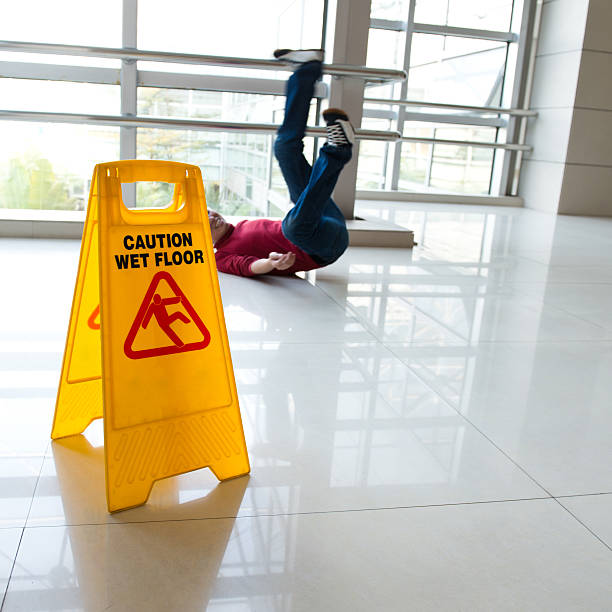
Some of the most common type of personal injury claims include slip & fall claim or a public liability claim. If you have been injured at a public place such as shopping centre, carpark or footpath and your accident was caused because of the failure of the other party to take reasonable steps to prevent the injury, then you may be entitled to compensation claim through public liability.
It is apparent fact that many people go through acute financial hardship because of someone else’s negligence. That is because they feel that they were partially responsible for the injury. There are many types of claims that qualify for slip and fall claim and are mentioned below:
- Slip & fall at shopping centres: This type of slip and fall are often caused by the slippery floor that are wet from cleaning, spills and roof leaf. The shopping centre management is responsible for such kind of hazards.
- Rental property Slip & fall: In this type of slip & fall the tenant is responsible for the slipping hazards.
- Hospital and Medical centres Slip & Fall: Medical Centres and hospitals are busy environments. Most of the time spillages can be left unattended which inevitably creates hazard for patients and people. In this instance, hospital and medical centre management is responsible for the slipping hazards.
- Public buildings slip & fall claims: public buildings include office buildings which can become slip & fall claims caused by roof leaks, water from wet umbrellas as well as spills. In this instance, building management is responsible for common areas for slipping hazards within their office spaces.
- Restaurant and Café Slip and fall claims: In restaurants the spillages are sometimes common and haven’t been cleaned. The owner of the restaurant is responsible for the safety of the customers and slipping hazards.
- Supermarket Slip & Fall: In supermarkets the spillages are caused by dropped fruits, or fridge leakage water and spills that haven’t been attended to or cleaned up. However, the supermarket manager is responsible for cleaning up the slipping risks.
It is very essential to have a successful public liability claim, to keep all the evidence and records of the accident. If you have fallen anywhere in the public space, you should instantly report the accident to the responsible person as soon as you can. The reporting of the accident would help to progress the initial investigation of the case.
For instance, you may report to the store manager or supermarket manager or building manager or homeowner or landlord.
Your Entitlements to claim under public liability
If you have a public liability claim to prosecute, then you may be entitled to the compensation for the following:
- Medical Treatment
- The care and help provided to your family member.
- Past loss of earnings
- Loss of future wages and future ability to earn.
- Loss of ability to look after anyone dependant.
- Pain & Suffering
- Loss of joy of life by physical or psychological injury
The compensation for liability is normally paid by the insurer of the large company, business, an Owner’s Corporation, an individual or the local council or Government body.
Duty of Care
The term Duty of Care refer to the legal obligations to take reasonable steps to avoid or prevent causing harm to others, where the damage is reasonably anticipated to occur if the care had not taken place.
Injuries to drivers, pedestrians and public transport users are all protected by a duty of care.
In the case of Furner v Jackson [2023] NSWSC 914 ( 03 August 2023), the agent was held accountable along with house owner for failing to take reasonable steps to prevent prospective buyers from driveway accidents and dangers in the properties.
Facts
On or around 18 Jan 2020, the plaintiff, Mrs Furner attended an open home sales inspections for a residential property located in Garden suburb in New South Wales
When Mrs Furner reached at the property, she proceeded to walk down the driveway located at the front of the property to get access to the house. Whilst walking down the driveway, Mrs Furner slipped and fell sustaining injuries. After being aided to her feet by her husband, Mrs Furner slipped again after just a handful steps. Mrs Furner bore injuries to her right hip, elbow and neck, which obliged multiple surgeries.
Mrs. Furner filed a lawsuit against the property’s owners as well as the real estate broker they hired to sell it.
Mrs. Furner said the agent was careless because of failing to notify her—or not warning her sufficiently—that the driveway surface was slick, even though it was known to be extremely slick, especially when wet.
Failure to install non-slip mats or other non-slip control measures over the driveway prior to the inspection; and Failure to complete any, or any acceptable, risk assessment of the slipperiness of the driveway surface, particularly when wet.
The owners painted the driveway and completed other corrective work on the property about a week before the open house sales inspection. According to Mrs. Furner, this resulted in driveway being slippery.
It was not raining at the time of the alleged accident; however, the driveway was wet from rain earlier that morning.
After Mrs Furner fell, she went to the sales agent and informed her about the slippery driveway. The sales agent also found that the driveway to be very slippery.
Issue
- Whether the owners and agents both negligent.
- Whether the risk of slipping on the newly painted driveway and sustaining injury was foreseeable and not significant
- Whether a reasonable person would have taken steps to prevent the harm from occurring
Decision
In order to make the property available to the public for the open house sales inspection on the day of the alleged occurrence, the Court found that the agent was the occupier of the property.
According to the Court, Mrs. Furner owed the owners and the agent a duty of care to make sure that she and other visitors could safely access and exit the property without slipping and falling on the extremely slippery driveway while it was wet. The Court specifically declared that the agent had a responsibility to use reasonable care and take reasonable precautions to reduce known risks of harm.
According to expert testimony that Mrs. Furner was able to obtain, there was a genuine and predictable risk associated with using the paint product on the driveway. The driveway’s extreme slickness when wet was acknowledged by the court. The Court determined that there was a foreseeable and serious risk of someone slipping on the steep slope.
The driveway seemed extremely slick and got slippery when wet, so the court concluded there was a good chance someone, like Mrs. Furner, would trip and fall on it.
According to the Court, the agent had a duty of care to alert potential buyers to the driveway’s potential for slipping, maybe by posting a warning sign to the effect that the slippery areas of the driveway. The court did not believe that these precautions to avoid the risk of harm from occurring was burdensome.
The Court determined that a reasonable person would have recognised that rain would make the steep driveway slick. The Court further stated that there was a very significant chance that someone might get serious injury if they slipped and fell on the driveway.
The owners and the agent broke their duty of care to Mrs. Furner by failing to exercise reasonable care, which led to the Court’s conclusion that they were negligent and caused Mrs. Furner to incur injuries and disabilities.
After finding in Mrs. Furner’s favour, the court granted her damages of more than $1.5 million.
Conclusion
This above decision establishes that the duty of care to take precautions against the risk of harm from occurring extends to the agent and homeowner as well as in their capacity as an occupier of the property for the purposes of public liability claim.
